Dice Have No Eyes Trinkets and Builds
Stop collecting every shiny object. Draft one synergy family and make the board obey.
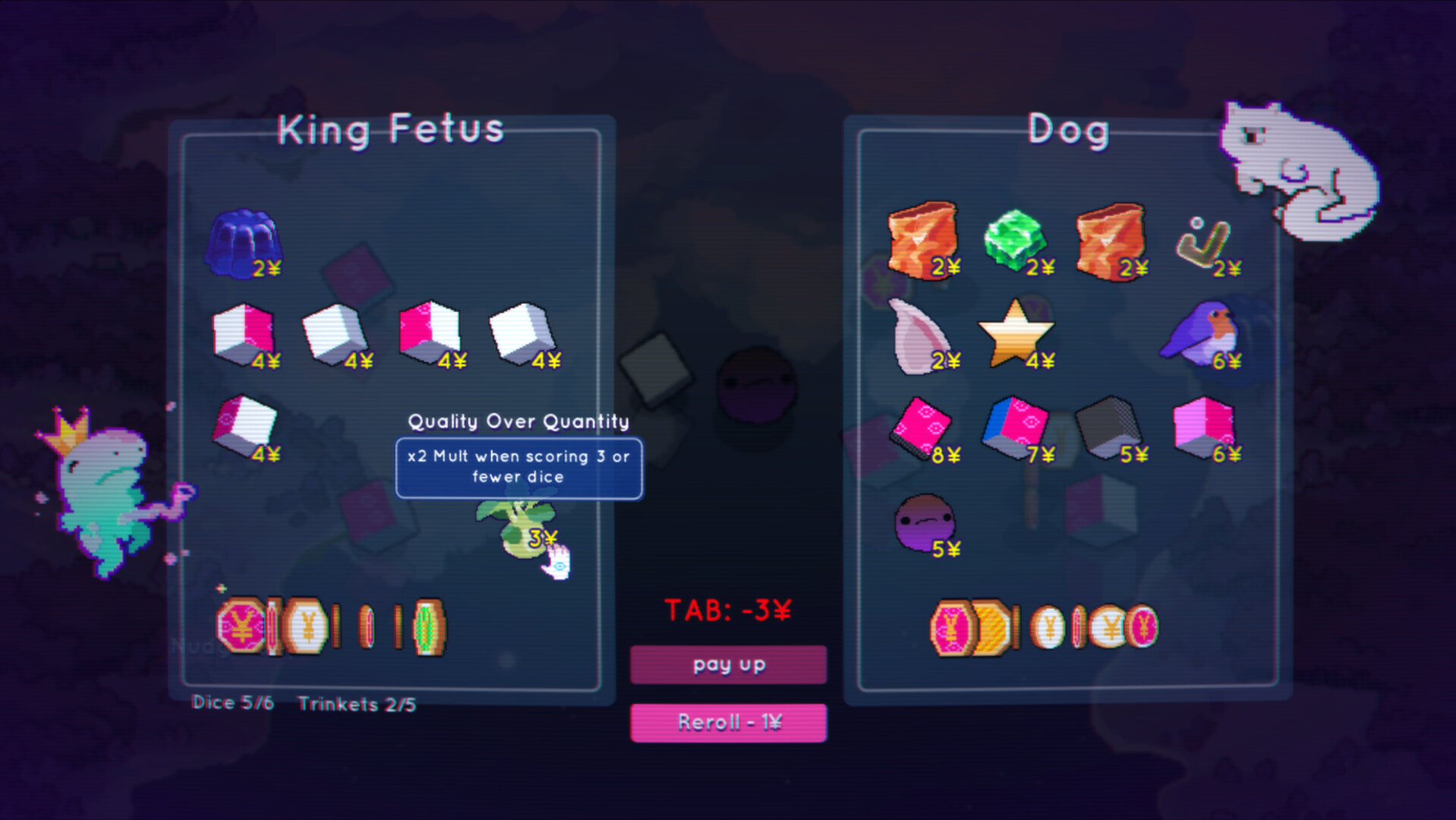
Dice Have No Eyes sells the fantasy of broken synergies for a reason: with 100+ trinkets, 40+ spells and snacks, magic dice effects, and 13 companions, a run dies when you draft five unfinished ideas. This page ranks build families after the 1.0 launch and explains how effects, babies, and snacks should talk to each other. Pair it with the character tier list so your face and your loot share a plan. For unlock and roster context, use the Characters Hub.
Draft philosophy before tiers
- Pick a verb. Copy (Mirror), advance (Skip), sustain (Hardy), threaten (Doom), convert (Anais smite / baby cash), or purge (Diet Culture style snack cleanses).
- Protect the verb with companions. A companion that saves rolls or softens busts is often worth more than a third greedy trinket.
- Spend snacks on purpose. Hoarding for a perfect moment is how Faraway Lands bets eat you. Use spells and snacks when a bust would erase a good board.
- Respect Depth. Shallows forgives messy drafts. Rift and God run punish them. Mid-run saves in 1.0 let you practice long drafts without losing the whole evening.
S-tier build families
Mirror copy engines
Mirror copies the value of the next selected die. The build fantasy is simple: create or find one excellent face, then duplicate it at the moment scoring cares. Strong Mirror packages combine:
- Trinkets that guarantee or bias high-value faces
- Companions that protect the setup roll from bust spirals
- Snacks that let you re-roll or stabilize before you lock the copy
Why S-tier: Mirror scales with your best die instead of asking the entire bag to be perfect. It thrives whenever scoring combinations care about matched values or when you need a temporary twin for a poker-like hand shape. Failure mode: copying garbage because you panicked. If the next die is wrong, Mirror becomes a self-own—bank or Skip instead.
Skip tempo loops
Skip auto-rolls to the next value. In greedy games, waiting for a face can be as deadly as busting. Skip builds remove dead time and let you chase specific sequences without burning the table’s patience—or yours.
S-tier when you already know which value you need for the hand, momentum bonus, or baby trigger. Pair Skip with effects that punish stalling and with companions that reward decisive short sequences (Hotdog-adjacent tempos love this). Watch Early Access Skip bug history: the July 2026 Skip fixes mattered, and 1.0 polish continues that reliability. If Skip feels wrong, check you are not stacking it into a kit that needed Hardy sustain instead.
Anais baby conversion
Not a single trinket—an economy. Feed dice, grow children, then smite for cash when the board is saturated. Parenting item lines that change as you play, baby-linked multiple score effects, and purge snacks that spit out negative sides all feed this family.
S-tier on longer Depths with shops dense enough to keep the nursery running. See Anais for timing rules. The build drops hard if you convert too early or starve the dice of the dumplings and snacks that make children worthwhile.
A-tier build families
Hardy sustain pushes
Hardy heals on roll. That sounds humble until you realize Dice Have No Eyes is a game about taking one more risk. Hardy packages let you press greed after a scare without pretending you are invincible.
A-tier because sustain wins leagues of average boards and shines on Rift’s long form. It is “only” A-tier on pure leaderboard greed when Mirror or baby engines outpace it. Draft Hardy when your character already has bust tools (Wizard) or tiny margins (Dog). Add snacks that cleanse bad sides so you are not healing through a doomed bag.
Doom pressure kits
Doom is the extreme cousin of cracked sides—huge threat, huge regret. Doom builds are for players who accept that some dice are haunted on purpose. You lean into volatile faces, back them with cash or score multipliers, and bank before the nightmare finishes you.
A-tier when you have the discipline to stop. C-tier behavior when you treat Doom like free power. Companions that grant emergency outs or extra bust room elevate Doom; companions that demand long stable sequences fight it. On Faraway Lands bets, Doom can print or delete your Stars story in one decision.
Companion-led tempo
Sometimes the trinket is not the star—the companion is. With thirteen unique powers, you can build around fewer rolls, more turns, self-eat loops (Hotdog), or other passives that change how often you touch the bag. A-tier when you draft trinkets that amplify the passive instead of ignoring it. If your companion wants fewer rolls, stop buying trinkets that demand six fiddly setups.
B-tier build families
Wide shop collectors
Picking “a bit of everything” from 100+ trinkets feels powerful and usually is not. B-tier at best: you survive Shallows, then stall when Rift asks for coherence. Upgrade rebalances in 1.0 make progression gentler, which ironically tempts players to over-collect. Spend the discount on finishing a verb.
Pure snack hoards
Spells and snacks are run-savers. Holding every dumpling for a hypothetical God run moment is how you die on level three. B-tier if you are learning timings; actively bad if you never press the button. Rule of thumb: spend a snack when it preserves a scored board you would be sad to lose.
Cosmetic-first drafts
1.0 adds character customization, distort effects, and cassette playlists. Fun—irrelevant to bust math. Keep fashion in the wardrobe and synergies on the table.
C-tier traps
- Copying trailer greed without a banking rule.
- Forcing Doom + Hotdog + bet max as a personality test.
- Ignoring babies on Anais or over-investing in babies on faces that cannot convert them.
- Building only for Shallows then wondering why Faraway Lands bets feel unfair.
- Refusing mid-run saves in 1.0 while practicing long Rift drafts—use the QoL.
Sample package blueprints
Blueprint: Wizard Mirror classroom
Goal: learn copy timing safely. Draft Mirror enablers, one Hardy piece, a companion with bust relief, and snacks that fix bad sides. Bank whenever the copied value already pays the level. Graduate to greed only after you can narrate why you rolled again.
Blueprint: Anais nursery printer
Goal: children into cash. Prioritize baby items, score-effect babies, purge snacks, and shop cash tools. Smite when the nursery is crowded and the next roll risks a wipe. Details on Anais.
Blueprint: Skip Hotdog spike
Goal: one-turn excellence. Skip toward the faces you need, spend snacks early, and do not draft five-turn sustain. If the spike fails, reset—do not invent a second turn the kit does not have.
Blueprint: Rift Hardy marathon
Goal: long board stability. Hardy, cleanse snacks, cautious bets, mid-run saves, companions that extend play. Leave pure Doom home unless you are hunting a specific achievement.
Synergy checklist mid-run
Ask every shop:
- Does this item finish my verb?
- Does it fight my companion?
- Does it assume a Depth I am not on?
- Will I actually spend the snack it enables?
- If I die next roll, did this purchase matter?
If you cannot answer quickly, buy nothing and bank knowledge for the next run. Leaderboards added in 1.0 reward coherent greed, not inventory tourism.
Related pages
- Tier List Hub for ranking philosophy
- Characters for face tiers
- Companions for the thirteen powers
- Version 1.0 for what changed in the full release
- Getting Started if you still need banking fundamentals
Broken synergies are real. Unfinished synergies are how the dice eat you.
Frequently Asked Questions
Quick answers to the most common questions.
What are the core dice effects to build around?
Mirror copies the next selected die, Skip auto-advances values, Hardy heals on roll, and Doom plays like an extreme cracked side. Draft one family instead of all four.
Should I always take babies?
Babies shine when your character or trinkets convert them—especially Anais smite cash and multiple score effects. On other kits they are optional, not mandatory.
How many trinkets should I aim for?
Enough to finish one verb. With 100+ options, coherence beats count. Over-collecting is a common Shallows habit that fails on Rift.
Do snacks expire if unused?
They expire in practice when you die holding them. Spend spells and snacks to save a good board rather than waiting for a perfect highlight.
Where do companions fit in a build?
Treat the companion passive as a build constraint. Amplify fewer-roll, multi-turn, or self-eat kits instead of drafting against them.